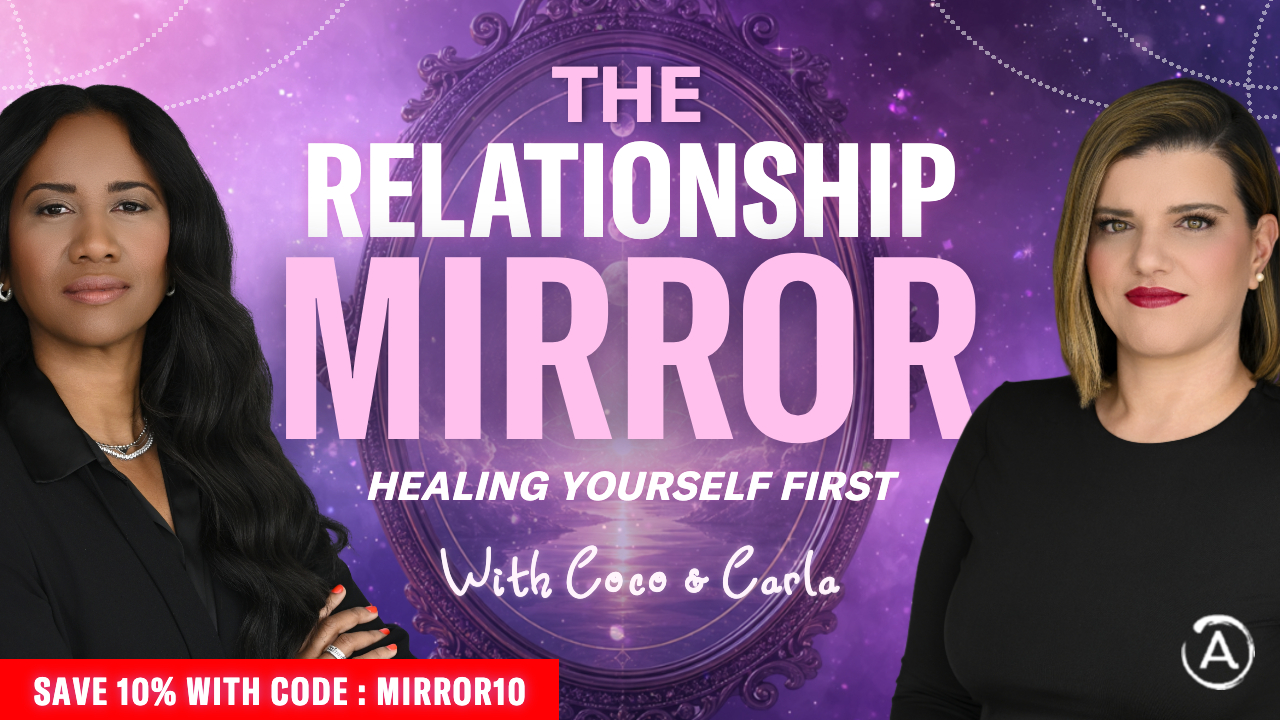
Why Do We Repeat the Same Relationship Patterns? The Relationship Mirror Explained
Have you ever looked back at your relationships and wondered why the same patterns keep showing up?
Different people. Different circumstances. Yet somehow, the same familiar feelings, conflicts, and disappointments return.
Maybe you're always the one giving more than you receive. Maybe you find yourself attracted to emotionally unavailable people. Or perhaps you've worked hard to heal from a difficult relationship, only to discover similar dynamics appearing in your next connection.
What if these repeating patterns are inviting you to understand something deeper about yourself?
If you've been following the Beyond Crystal Show with Coco and Carla, you've probably heard us explore this idea before:
Your outer relationships can act as a mirror of your inner world.
But what does that actually mean? And more importantly, how can understanding this mirror help you create healthier, more fulfilling relationships?
The Relationship Mirror: What Are Your Relationships Showing You?
There's an ancient spiritual principle that says, "As within, so without."
From a spiritual perspective, our relationships can reflect aspects of our beliefs, emotional wounds, expectations, and energetic patterns.
The people we connect with, the dynamics we participate in, and the reactions we experience can offer opportunities to examine what's happening within us.
But this doesn't mean you're responsible for someone else's harmful behaviour.
Understanding your relationship patterns isn't about blame. It's about awareness.
It's about recognising what belongs to you, what belongs to someone else, and where you have the power to make different choices.
Instead of asking only, "Why does this keep happening to me?" we can begin asking a different question:
"What can I learn about my needs, boundaries, and patterns from this experience?"
That shift can be the beginning of meaningful change.
The Question Beneath the Question: What Is Your Relationship With Yourself?
Before we can fully understand our relationships with others, we need to explore the relationship we have with ourselves.
Not the version we present to the world.
Not the version we believe we should be.
But the relationship that exists beneath our coping mechanisms, protective behaviours, fears, and expectations.
Think about it.
How comfortable are you expressing your needs?
Do you feel guilty when you set boundaries?
Do you find yourself seeking reassurance or approval from others?
Are you afraid of abandonment, rejection, or conflict?
These questions can reveal patterns that influence how we connect with the people around us.
Where Do These Patterns Come From?
Many of our relationship responses develop long before we become consciously aware of them.
Our early experiences, attachment relationships, family dynamics, and emotional environment can shape how we interpret love, safety, trust, and connection.
This is where concepts such as attachment styles, inner child work, and trauma responses become valuable.
We may also recognise recurring themes connected to emotional wounds such as:
- Abandonment
- Rejection
- Betrayal
- Humiliation
- Injustice
Our ego can play a role too.
Often misunderstood as arrogance or selfishness, the ego can also be understood as part of the identity and protective responses we've developed throughout life.
It may influence how we react to criticism, perceive rejection, or defend ourselves during conflict.
These patterns aren't necessarily character flaws. Many began as ways of protecting ourselves.
And once we begin recognising them, we can start making more conscious choices.
The Missing Piece: Exploring the Energetic Side of Relationships
Most relationship programmes focus on communication, attachment styles, emotional intelligence, and boundaries.
And these are incredibly valuable tools.
But for those of us who approach life through a spiritual lens, there's another dimension worth exploring.
The energetic experience of relationships.
Have you ever walked away from a conversation feeling completely drained?
Found yourself thinking about someone long after a relationship ended?
Or felt emotionally connected to a person even when you consciously knew it was time to move forward?
These experiences can have psychological and emotional explanations. Within spiritual traditions, they're also explored through concepts such as energetic cords, soul connections, and energetic boundaries.
At Beyond Mystic, we believe there's value in exploring both perspectives.
Not choosing intuition over logic, or spirituality over psychology, but allowing different approaches to inform our understanding.
Energetic Cords, Boundaries, and Letting Go
In spiritual practices, energetic cords are used as a way of describing the connections we feel with others.
Cord-cutting rituals can offer a symbolic practice for releasing emotional attachments, setting intentions, and creating space for new beginnings.
For empaths and highly sensitive individuals, practices involving grounding, visualisation, and energetic boundaries can also provide opportunities for reflection and self-care.
And sometimes, having a physical object to anchor that intention can be meaningful.
That's where crystals come into the conversation.
For example, shungite and black tourmaline are traditionally associated with grounding and protection in crystal practices.
While crystals aren't scientifically established treatments for emotional or psychological difficulties, they can serve as personal reminders of the boundaries and intentions we're working to strengthen.
The important part isn't the object itself.
It's the awareness and conscious action we bring to the process.
Recognising Harmful Relationship Dynamics
One of the most important aspects of relationship healing is learning to distinguish between our own emotional patterns and the harmful behaviours of others.
Not every difficult relationship is a reflection of something we need to heal within ourselves.
Sometimes, another person is behaving in ways that are genuinely manipulative, controlling, or emotionally harmful.
Understanding behaviours associated with gaslighting, narcissism, codependency, and emotional manipulation can help us recognise when a relationship is affecting our wellbeing.
It can also help us understand why setting boundaries or leaving certain dynamics can feel so difficult.
Spiritual growth should never require you to tolerate mistreatment.
And healing doesn't mean taking responsibility for someone else's actions.
It means developing the discernment to recognise what's happening, trust your experiences, an
Ready to explore your own Relationship Mirror?
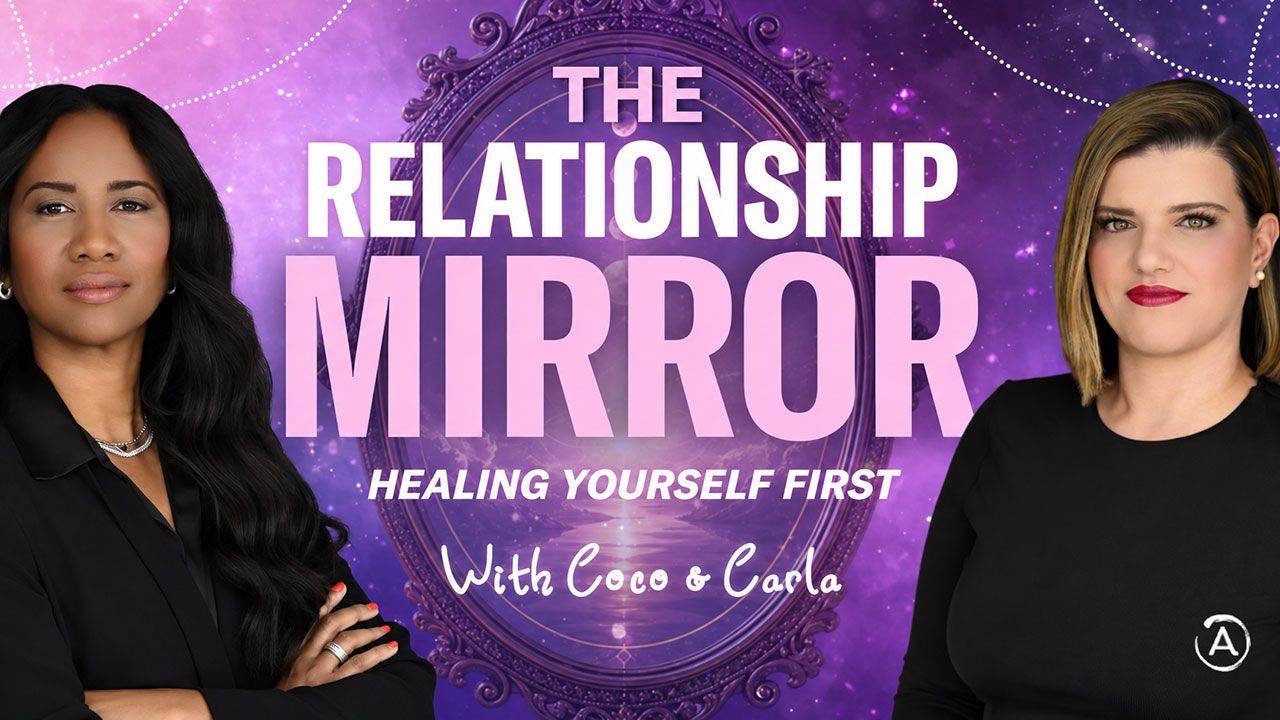
Join Carla and Coco for The Relationship Mirror: Healing Yourself First, a nine-module, self-paced course designed to help you understand your relationship patterns, heal emotional wounds, strengthen your boundaries, and create healthier, more conscious connections.